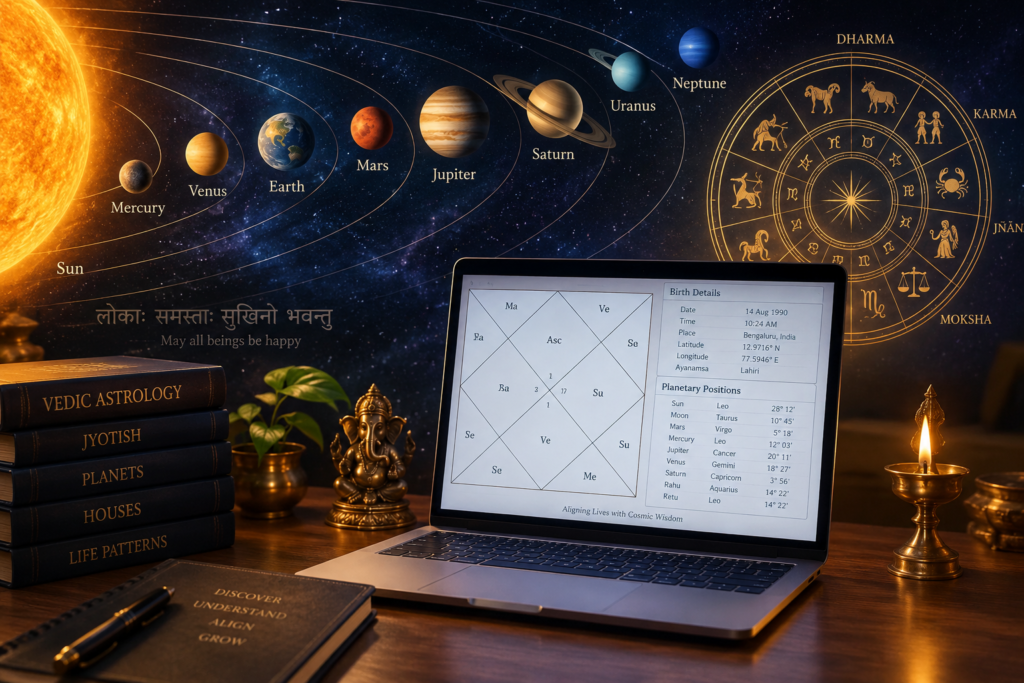
Every batch, someone asks in the first week why they are not allowed to open a chart calculation app. It is a fair question. The software is free, it is fast, and it does not make arithmetic errors at eleven at night.
The answer is that the software will never tell you when it is wrong, and it is wrong more often than people expect.
What the calculation actually teaches
Casting a lagna by hand is tedious. You work through the sunrise time, the birth time, the ayanamsa, and the local correction, and it takes twenty minutes the first time. By the fourth week it takes four minutes.
What has changed in those four weeks is not your speed. It is that you now know, without thinking, roughly where the ascendant ought to fall for a given birth time and place. When a piece of software hands you something else, you notice.
Understanding the principle behind a prediction matters more than arriving at it quickly. A student who cannot check the machine is working for the machine.
Where software goes wrong
Three failures come up repeatedly in the questions students send:
- The ayanamsa setting is left on a default that does not match the tradition being taught, and every position shifts.
- The birth place is matched to the wrong town, which happens constantly with common Kerala place names.
- The time zone is applied twice, or not at all, for births recorded before standardisation.
None of these produce an obviously broken chart. They produce a plausible chart that is quietly wrong, and a beginner has no way to tell the difference.
From week five
We introduce free software in the fifth week and use it for the rest of the course. Nobody is expected to keep calculating by hand for a professional consultation. The point was never the arithmetic.
The point is that when the screen shows you a chart, you are checking it rather than trusting it.